

Many advertising strategies are built around spikes: sudden budget increases, aggressive testing bursts, or short-term optimizations designed to chase quick wins. While these tactics can deliver temporary lifts, they often lead to volatility, rising costs, and performance decay.
Consistent ad performance, by contrast, is grounded in behavioral science and statistical reliability. Stable delivery creates better learning conditions for platforms, stronger audience signals, and more reliable conversion outcomes over time.
How Algorithms Learn: The Role of Statistical Stability
Modern ad platforms rely on machine learning systems that optimize delivery based on historical performance signals. These systems require sufficient data volume and consistency to identify meaningful patterns.
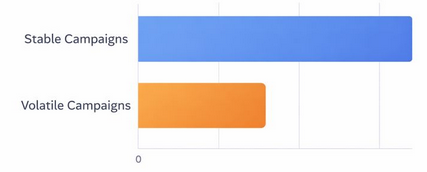
Lower cost per acquisition achieved by campaigns with stable budgets and targeting structures
Frequent structural changes—large budget swings, creative resets, or targeting overhauls—interrupt this learning process. Research across major ad platforms shows that campaigns with stable budgets and targeting structures achieve up to 20–30% lower cost per acquisition compared to highly volatile setups once fully optimized.
Stability reduces noise in the data, allowing algorithms to differentiate between random fluctuations and true performance signals.
Cognitive Science and Repeated Exposure
Human decision-making is heavily influenced by familiarity. The mere exposure effect demonstrates that repeated, consistent exposure to a message increases trust and preference—even without conscious awareness.
Marketing studies indicate that:
-
Brand recall increases by approximately 60–70% after 3–5 consistent exposures
-
Purchase intent rises significantly when frequency is controlled and messaging remains coherent
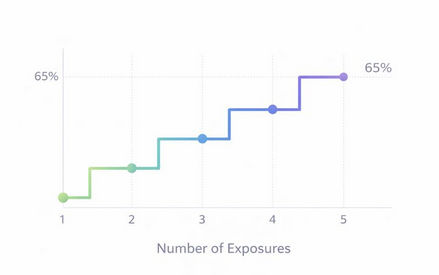
Brand recall improves with repeated ad exposures, peaking around 3–5 consistent impressions
Erratic creative changes or inconsistent messaging weaken this effect, forcing audiences to restart the recognition process rather than progressing toward conversion.
Variance, Noise, and Misleading Wins
Short-term performance spikes are often statistical outliers rather than sustainable improvements. When budgets scale rapidly or tests run on insufficient sample sizes, results can appear strong but fail to hold.
From a statistical standpoint:\n- Small data sets exaggerate variance
-
High variance increases the likelihood of false positives
-
False positives lead to over-optimization and long-term inefficiency
Consistent performance emerges when decisions are based on trends observed over longer periods with adequate sample sizes, reducing the impact of randomness.
The Compound Effect of Incremental Optimization
Stable campaigns allow for gradual, controlled improvements. Small optimizations—such as refining creative elements, improving landing page load time, or tightening audience exclusions—compound over time.
Industry benchmarks suggest that advertisers who apply incremental optimizations within stable campaign structures can achieve:
-
10–15% efficiency gains per quarter
-
More predictable revenue forecasting
-
Lower performance volatility during scaling phases
Consistency enables learning to stack rather than reset.
Why Consistency Protects Performance During Scale
Scaling amplifies both strengths and weaknesses. In unstable systems, scaling magnifies inefficiencies. In stable systems, it amplifies proven signals.
Campaigns built on consistent delivery tend to:
-
Exit learning phases faster
-
Maintain lower CPM volatility
-
Preserve conversion rates as spend increases
This is why long-term growth strategies prioritize controlled scaling over aggressive expansion.
Conclusion
Consistent ad performance is not conservative—it is scientific. By aligning with how algorithms learn, how humans make decisions, and how statistics behave, advertisers can replace unpredictable spikes with sustainable growth.
Stability creates clarity. Clarity enables optimization. And optimization, when compounded over time, produces durable performance.
