

Local advertising on Facebook and Instagram works best when targeting reflects real community behavior. Facebook group audiences help advertisers reach people connected by location, shared needs, or specific interests.
These audiences are active and opinionated. Many members are already researching options or asking for recommendations. For local campaigns, that level of intent matters.
Why Use Facebook Groups for Local Targeting
Facebook groups function as discussion spaces, not passive feeds. Members join to ask questions, compare options, and learn from others nearby.
This creates clear signals that standard interest targeting often misses.
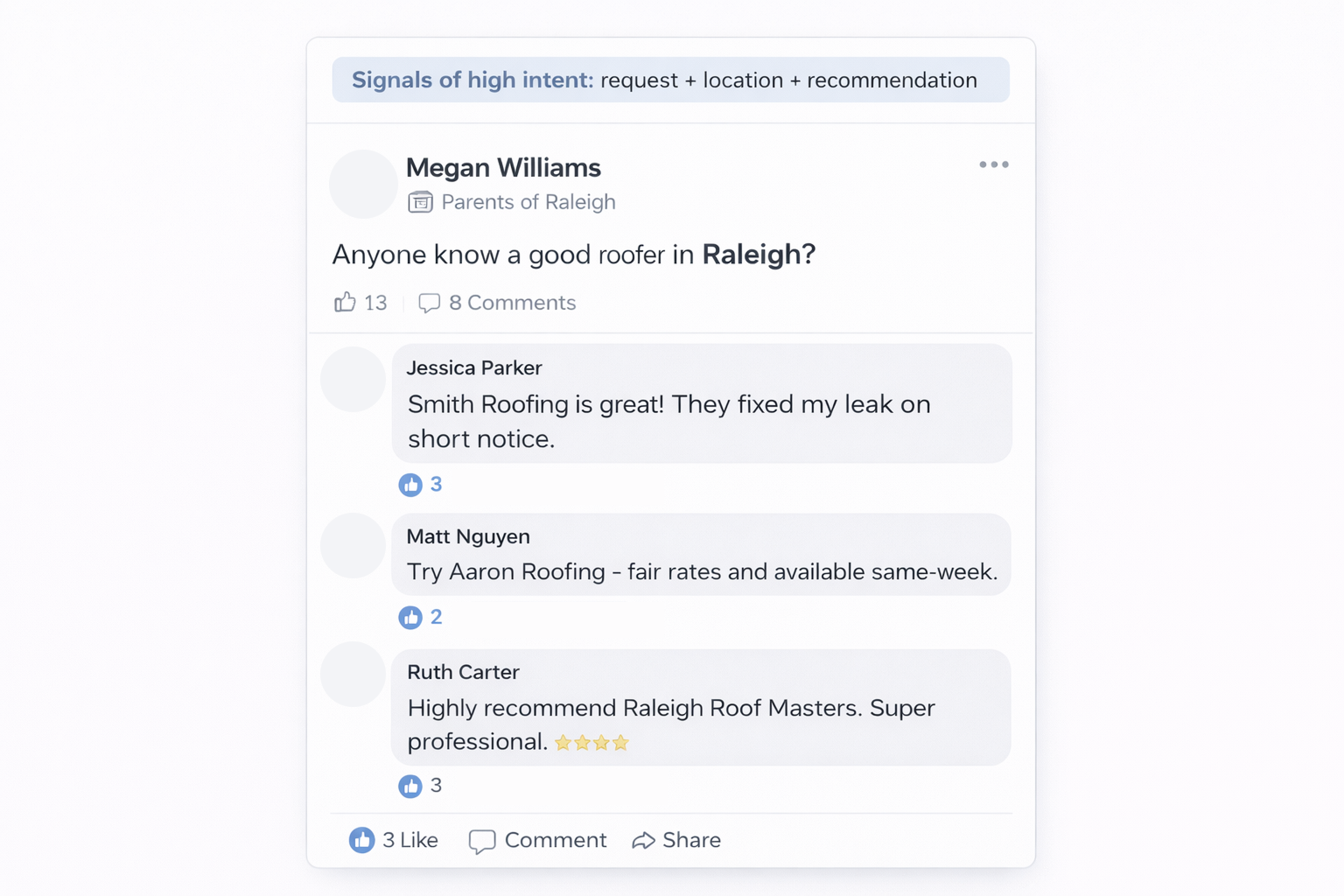
Group members regularly:
-
Ask for local service recommendations;
-
Discuss pricing, availability, and quality;
-
Share experiences after purchasing or visiting a business.
When ads reflect these conversations, they feel timely and relevant.
See why group audiences often outperform standard targeting: Why Group Membership Predicts Purchase Intent Better Than Interests.
Best Types of Facebook Groups for Local Business Targeting
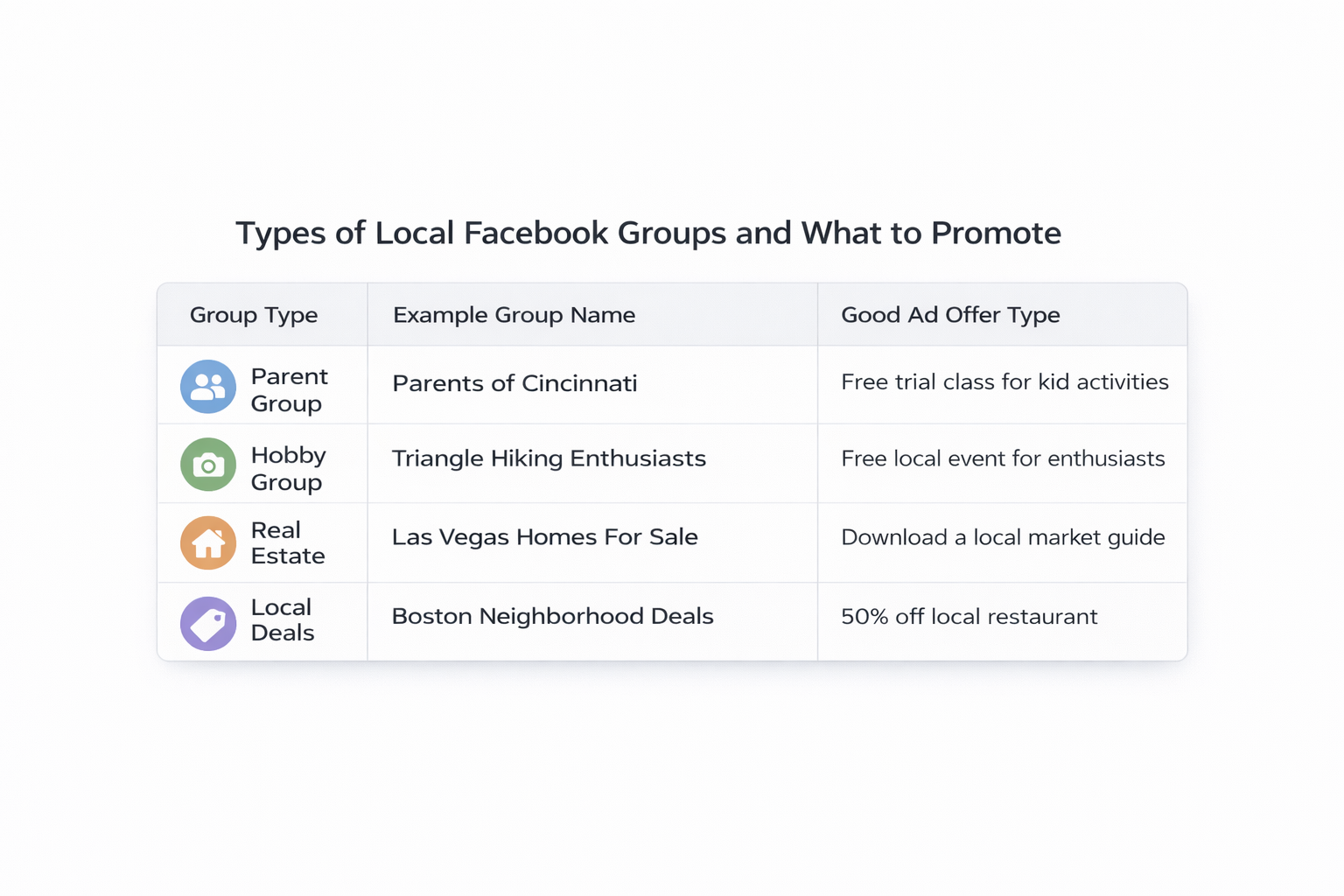
Different group types support different local goals:
-
Neighborhood groups, such as “Downtown Austin Residents,” useful for cafes, gyms, and local retail.
-
Parent groups, like “Phoenix Moms Network,” effective for dentists, tutoring, and kids’ activities.
-
Hobby groups, such as “Seattle Trail Runners,” relevant for specialty retail and services.
-
Buy/sell/trade groups, often strong for home services and local shops.
-
Relocation groups, like “Moving to Raleigh,” valuable for real estate and moving companies.
Each group type reflects a specific kind of demand. Choose based on how customers usually find your business.
Top Benefits of Using Facebook Group Audiences for Local Ads
Facebook group audiences give local advertisers advantages that are difficult to replicate with interests or demographics alone. These benefits come from how people use groups and why they join them.
People join groups intentionally. They are not placed there by an algorithm. That intent changes how they respond to ads.
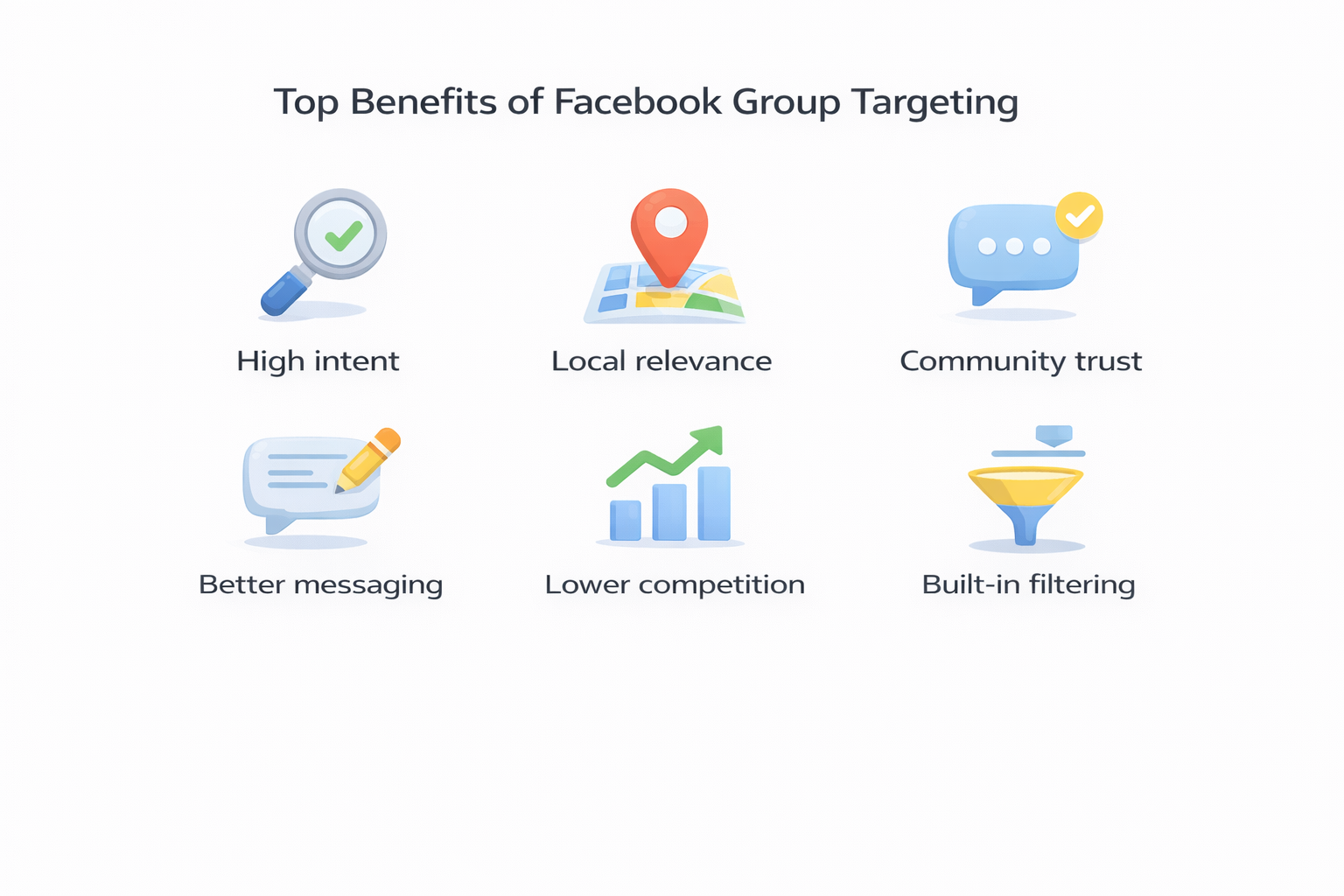
Key advantages of group-based local targeting
-
Stronger purchase intent
Many groups exist because members are actively looking for solutions. A group like “Best Plumbers in Phoenix” or “Daycares in North Jersey” signals immediate need. You’re reaching people closer to a decision. -
Context-driven relevance
Group membership provides context interests can’t. Someone interested in “fitness” may live anywhere. Someone in “Brooklyn CrossFit Community” gives you location, lifestyle, and intent at once. -
Higher trust by default
Local groups rely heavily on recommendations. Ads that address common group problems feel familiar, not disruptive. This often reduces resistance compared to cold targeting. -
Clearer messaging signals
Group discussions show how people describe their problems in real terms. You can reuse that language in headlines, offers, and ad copy. This usually improves engagement. -
Lower competition
Most local advertisers still rely on interest or radius targeting. Group-based audiences are less crowded, which often leads to lower CPMs and steadier delivery. -
Built-in local filtering
Many groups already limit members by city or neighborhood. This reduces wasted spend even before applying geo-filters.
After launch, advertisers often see faster performance signals. Higher intent means clicks, calls, or leads appear sooner, which simplifies testing.
How to Use LeadEnforce to Create Facebook Group-Based Custom Audiences
Meta Ads Manager does not allow direct targeting of Facebook group members. LeadEnforce solves this by letting you build custom audiences from public group followers and engaged users.
Want a full walkthrough? Check out How to Build Your Target Audience from a Facebook Group.
Step 1: Find relevant Facebook groups for your business
Start by finding active, public groups related to your business and location. Prioritize:
-
Large member counts;
-
Recent posts and comments;
-
Clear local or problem-specific focus.
Very small or inactive groups usually don’t provide enough volume.
Step 2: Build a custom audience with LeadEnforce
Inside LeadEnforce:
-
Add the URLs of selected Facebook groups;
-
The platform collects users who follow or engage with those groups;
-
A custom audience is created from this data.
Use multiple groups whenever possible. This helps keep the audience large enough if you apply additional filters later.
Step 3: Share your audience to Facebook Ads Manager
Once the audience is ready:
-
Share it directly to your connected Facebook Ad Account;
-
Open Ads Manager and create or edit a campaign;
-
At the Ad Set level, select the audience under “Custom Audiences.”
You can apply additional filters, such as location or age. Each filter reduces audience size. To avoid delivery issues:
-
Use several relevant groups as sources;
-
Prefer groups with large followings;
-
Avoid overly narrow geo-filters when groups are already local.
For more help on using LeadEnforce for local growth, read: How LeadEnforce Helps Local Businesses Reach the Right Customers.
Using Facebook Group Audiences: Examples
Local fitness studio
-
Group: “Dallas Working Moms”.
-
Ad: “Morning strength classes near Lakewood. Drop in after school drop-off. First session free.”
-
Why it works: Matches schedule, location, and daily routine.
Home cleaning service
-
Group: “San Jose Homeowners”.
-
Ad: “Move-out cleaning for condos and townhomes. Same-week availability in San Jose.”
-
Why it works: Targets homeowners with a time-sensitive need.
Real estate agent
-
Group: “Moving to Tampa Bay”.
-
Ad: “Relocating to Tampa? Download a neighborhood guide with prices and commute times.”
-
Why it works: Fits early research behavior without pushing a hard sale.
Specialty bakery
-
Group: “Brooklyn Gluten-Free Community”.
-
Ad: “Certified gluten-free pastries baked daily in Williamsburg. Pre-orders open for weekends.”
-
Why it works: Highly specific to diet and location.
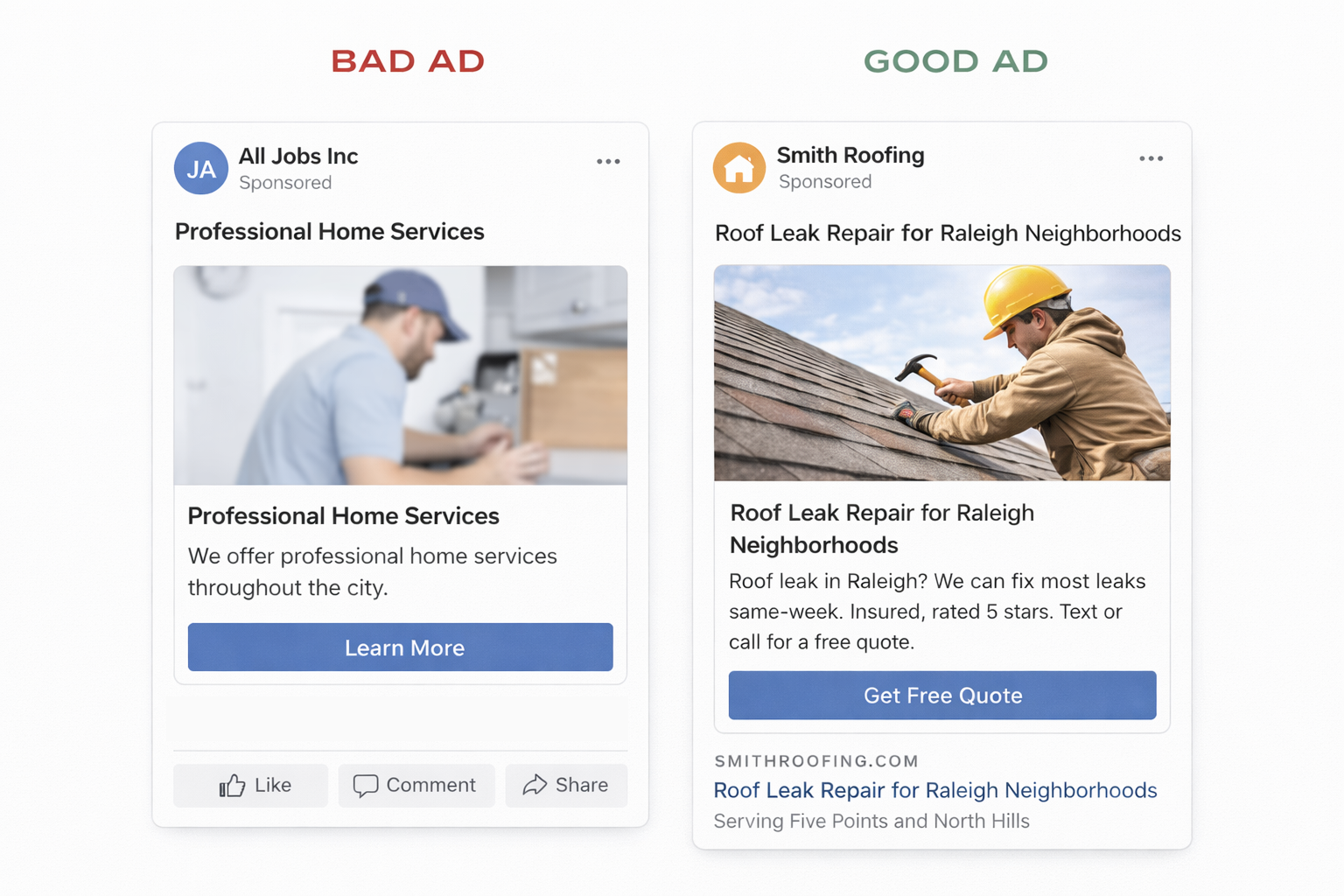
Best Practices for Writing Local Ads Targeting Facebook Group Audiences
How to Scale Local Campaigns Using Facebook Lookalike Audiences
Once your group-based audience is performing well, you can scale by creating a lookalike audience that shares the same traits.
Here’s how:
-
Identify the strongest-performing group audience.
-
Create a 1% lookalike audience from it in Facebook Ads Manager.
-
Limit the lookalike to your service area (city or region).
-
Use your best-performing creatives.
Learn how lookalike audiences compare to custom targeting: Custom vs Lookalike Audiences: What Works Best for Facebook Campaigns?
This allows you to reach more people with similar behaviors, while staying local
How to Measure Success in Local Facebook Ad Campaigns
For local businesses, it’s not just about clicks. Measure actions that reflect real customer interest or intent.
Track:
-
Phone calls or messages from the ad;
-
Appointment requests or quote forms;
-
In-store visits (if available with offline tracking);
-
Coupon code redemptions.
Short-term actions often matter more than long-term conversions in local campaigns.
Conclusion
Facebook groups reflect real conversations, real problems, and real intent. When used right, they offer a unique edge for local advertisers trying to stand out.
With LeadEnforce, you can access these group audiences directly — turning organic community signals into high-performing Facebook and Instagram ads.
If you’re running local campaigns and not using group-based audiences yet, now is the time to start. It’s one of the most precise and underused tactics in local digital advertising.
