

Landing pages are not one-size-fits-all. The way people arrive on a page shapes what they expect to see and how they act. If you're running Facebook, Instagram, or Google Ads, the wrong landing experience can waste your ad spend — even if the ad itself is working.
This article explains how landing pages should differ depending on the ad type, especially for paid social vs paid search.
Why landing pages need to match traffic source
Not all clicks are equal. People coming from Google search have intent. They’re actively looking for something. Social media users are often interrupted — stopping mid-scroll because your ad caught their attention.
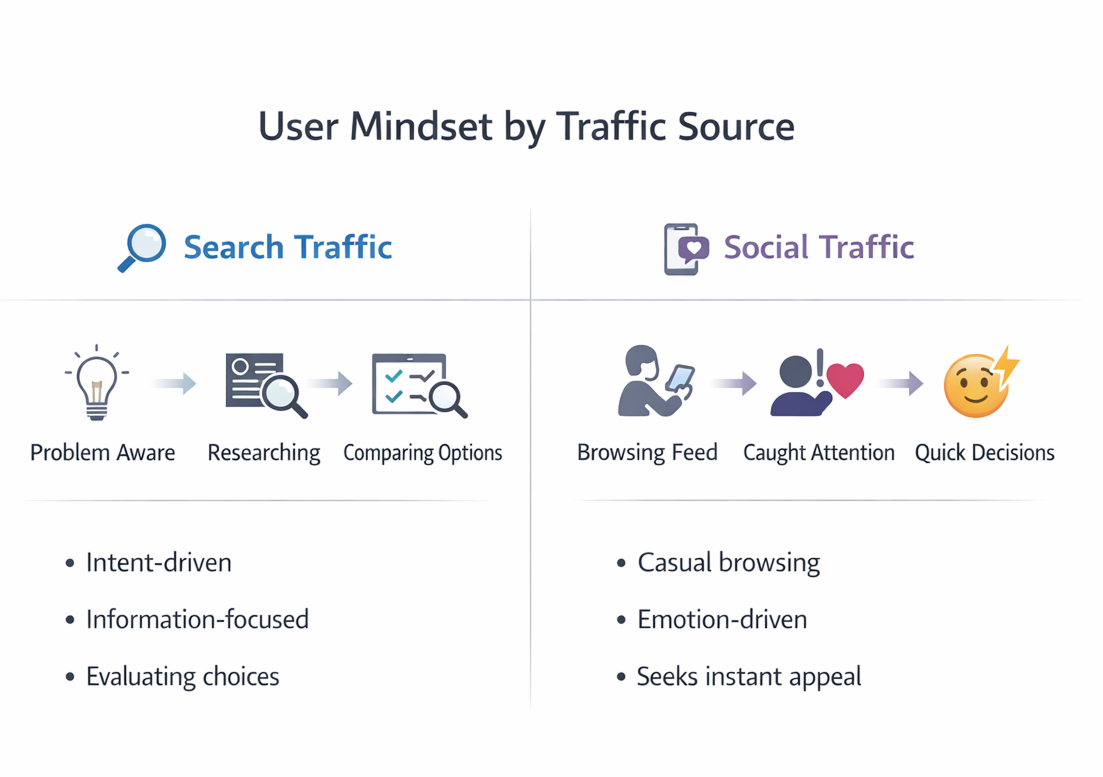
This difference changes how you design and structure your landing page.
What to know about social ad traffic
Low intent, high distraction
People clicking Facebook or Instagram ads are not actively shopping. They’re browsing friends, memes, and local news. Your page must immediately answer two things:
-
What is this? Clear visuals and messaging in the first 2–3 seconds;
-
Why should I care? A strong, specific value proposition.
Avoid long intros or brand stories at the top. Start with what matters to the user now.
You’ll find more tips for this use case in this article on optimizing landing pages for e-commerce.
Mobile-first is mandatory
Social traffic is almost always mobile. That means:
-
Large, fast-loading visuals;
-
Short text blocks;
-
Tap-friendly buttons;
-
No desktop-only elements like hover menus or sidebars.
Test pages in real mobile conditions — low bandwidth, glare, and short attention spans.
Social proof matters more
Unlike Google searchers, social users didn’t ask for your product. They’re more skeptical. Add:
-
Real user reviews, ideally from Facebook or Instagram comments;
-
Visual testimonials or influencer reels;
-
Contextual proof, like “Used by 400+ Brooklyn CrossFit members.”
Trust is the main conversion driver in social traffic.
What to know about search ad traffic
High intent, task-oriented users
If someone Googles “best CRM for real estate,” they want a solution now. Your page should:
-
Confirm relevance fast ("CRM built for real estate agents");
-
Offer a direct next step (demo, quote, or sign-up);
-
Include specifics (features, pricing, comparisons).
Generic “solutions for every business” don’t work here.
More info = better conversions
Unlike social traffic, search users often want details. Don’t be afraid to include:
-
Feature breakdowns;
-
FAQs;
-
Performance claims, backed by data;
-
Technical specs or integration lists.
You’re helping people evaluate, not just discover.
You can improve results by using strategies covered in this guide to creating a high-converting landing page.
Navigation and options are okay
Search visitors are often in research mode. It’s fine to have:
-
A top nav menu;
-
Links to feature pages;
-
Pricing comparisons.
Just don’t overload the page. Keep CTAs visible and focused.
Key differences at a glance
| Element | Social ads (Facebook, Instagram) | Search ads (Google) |
|---|---|---|
| User intent | Passive, low intent | Active, high intent |
| First impression | Emotional appeal, visual hook | Relevance and clarity |
| Page length | Short, scroll-friendly | Can be long, detail-rich |
| Device priority | Mobile-first | Mobile-important, but desktop viable |
| Trust signals | Social proof, user-generated content | Ratings, awards, feature lists |
| CTA style | One focused CTA (e.g., “Try Now”) | Optional CTAs, multiple paths |
How to structure a landing page for paid social
What to show in the first screen
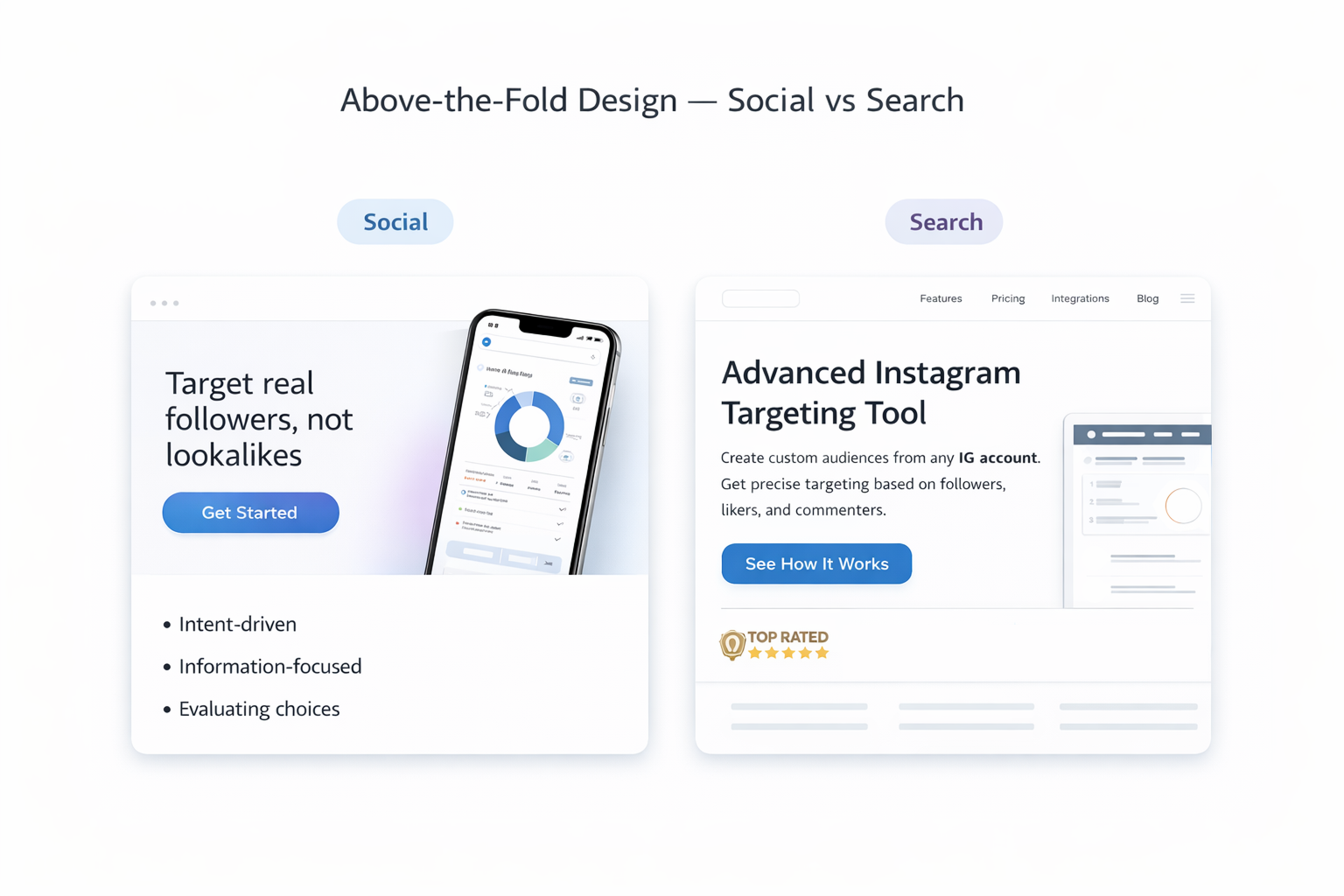
Above the fold, include:
-
A product image or mockup in use;
-
One-line value proposition ("Target real followers, not lookalikes");
-
A single CTA (like “Get Started” or “See How It Works”).
No sliders. No videos that autoplay with sound. Keep it quick.
Content that builds momentum
Use the scroll to layer in:
-
Visual proof of results;
-
One or two benefit explanations;
-
Trust boosters (logos, short testimonials).
Avoid dense paragraphs or complex comparisons. Think “glanceable” not “thorough.”
How to structure a landing page for paid search
Match the query language
If your ad was triggered by "Instagram targeting tool", say those words on the page. Use:
-
Headline that reflects the search;
-
Subhead that adds value ("Create custom audiences from any Instagram account");
-
Bullet list of differentiators.
Avoid vague claims like “The best targeting platform.” Be specific.
Support exploration
Below the CTA, include:
-
Detailed use cases (e.g., for e-commerce, agencies, local ads);
-
Optional comparison tables;
-
Links to deeper pages, like integrations or pricing.
Search users often return multiple times. Make their next visit easier.
What not to do on either type of landing page
Even well-designed landing pages can fail if they ignore how people arrive there. These common mistakes lead to higher bounce rates and lower conversion — regardless of how good your offer is.
Avoid the following:
-
Don’t force account creation too early.
Asking for sign-up before showing value drives visitors away — especially from Facebook or Instagram ads.
Example: An e-commerce store asks users to “Create an account” before viewing products. Instead, show top sellers first, then prompt login at checkout. -
Don’t gate everything behind forms.
Let users interact with the product, tool, or content first.
Example: A SaaS tool with a “See Pricing” button that leads to a form wall. Instead, offer a preview of features before asking for email. -
Don’t reuse the same landing page across all campaigns.
A generic page can mismatch the ad’s promise and reduce conversions.
Example: A search ad for “Instagram targeting software” leads to the same homepage used for retargeting. Instead, create a tailored page that mirrors search intent and keyword language. -
Don’t forget to match the page to traffic source.
Social traffic often needs fast, visual proof; search traffic wants clear product details.
Example: Showing a long product comparison chart to someone from an Instagram ad. Use a short, benefit-focused version instead.
Treat every landing page like a response to the user’s mindset. The more aligned it is with the source of the click, the more likely you are to convert that visit into action.
Final takeaway
The best landing page isn’t the prettiest — it’s the one that matches user intent. Social and search traffic need different approaches. If you're running Facebook and Instagram ads with tools like LeadEnforce, don’t waste that targeting with the wrong page.
To go deeper into aligning offers with traffic, read about why landing pages outperform lead forms in some cases.
Align page structure with how your audience thinks and acts. Test. Improve. Iterate. It’s the only way to make paid clicks profitable.
